
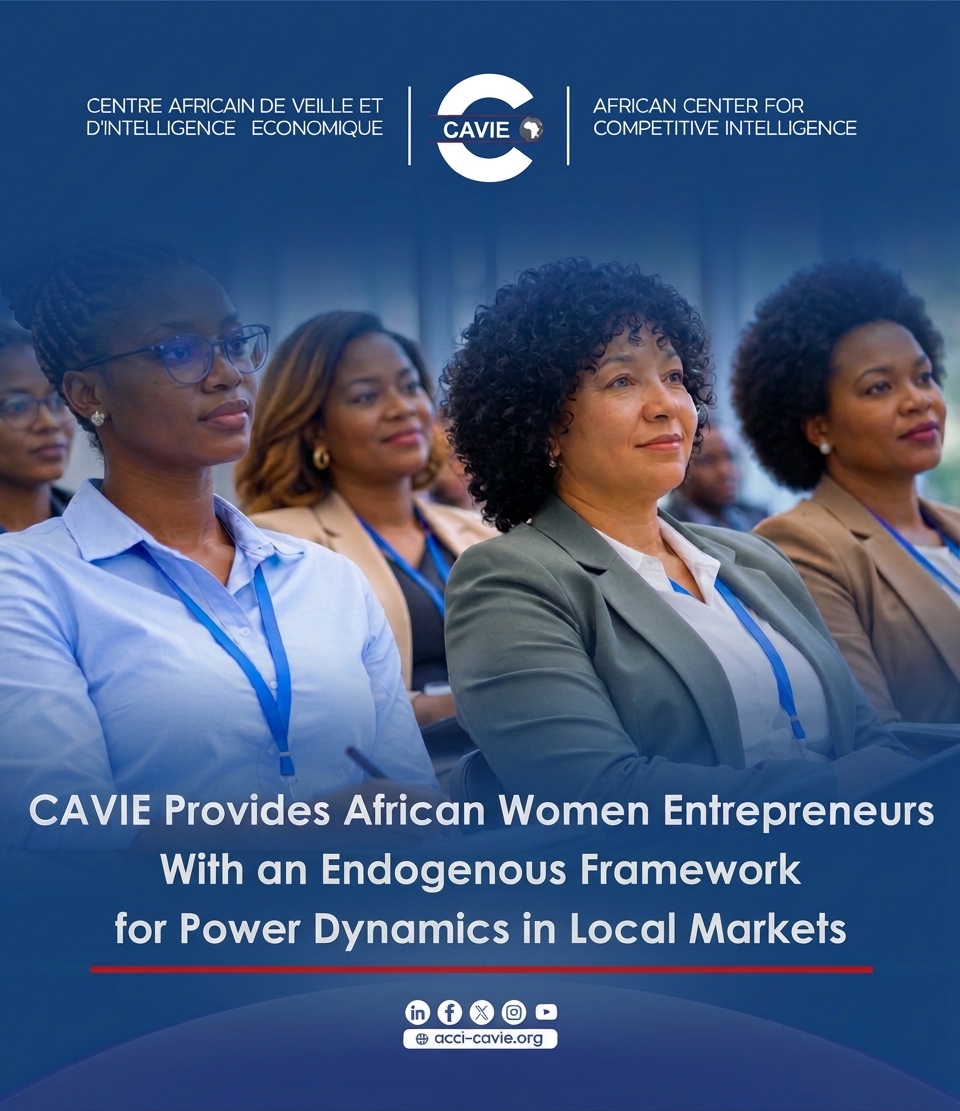
In South Africa, before an audience of 150 women business owners, the African Center for Competitive Intelligence (CAVIE) demonstrated how SMEs can turn rules, market data and weak signals into competitive advantages under the African Continental Free Trade Area (AfCFTA). Beyond the session held on 29 October 2026, the aim is to embed African Competitive Intelligence as a shared reflex serving protection, market expansion and influence. For African SMEs, AfCFTA opportunities go beyond tariff reductions. Benefiting from the continental market also requires reliable information, regulatory monitoring, competitive analysis and the ability to identify trustworthy business partners.
AfCFTA Opportunities for SMEs: Why Knowing the Rules Matters
Trade liberalisation does not make barriers disappear. Businesses must still understand customs procedures, rules of origin, sanitary and phytosanitary (SPS) standards, documentation requirements, temporary restrictions and non-tariff barriers. A tariff preference may remain unusable if a product does not meet origin criteria or if a certificate is missing at customs clearance. An opportunity identified too late can also become an additional cost.
The first requirement, therefore, is to treat regulation as strategic information. The aim is not to turn every executive into a lawyer, but to give business leaders the means to know which rules apply to their product, in the target country, on the shipment date. Ongoing regulatory monitoring makes it possible to identify tariff changes, new standards, bans or additional formalities before they disrupt an order or a commercial season.
The second requirement is to avoid confusing an abundance of information with useful knowledge. Trade data are scattered across government agencies, statistical databases, professional organisations, sector platforms and private sources. The method presented in Sandton reverses the usual sequence: start with a decision that needs to be made, formulate the question that will help inform it, select relevant sources, and then cross-check the information before taking action.
Five Categories of Signals to Avoid Monitoring Blindly
For an SME, monitoring should not attempt to cover everything. It should focus on information that could change a decision. In Sandton, the approach was organised around five complementary monitoring areas.
The Market: Assess Demand Before Producing
Imports, price levels, supply shortages and seasonal variations provide an initial picture of market opportunities. A drought in a neighbouring country, for example, may create an opportunity for a regional producer. But this window may be short: the business still needs to know the volumes sought, market access conditions and the logistics capacity required to deliver on time.
Competitors: Look Beyond Immediate Neighbours
A business must identify the origin of imports, the brands already present, active distributors and supply routes. Its most serious competitor is not necessarily based in its own country. It may be Zambian, Kenyan or South African, with better-controlled transport costs, a stronger distribution network or a better understanding of buyers’ requirements.
Regulation: Anticipate Bottlenecks
Applicable duties, rules of origin, SPS standards, non-tariff barriers and any import bans must be monitored over time. A regulatory change can make a transaction less profitable, delay customs clearance or temporarily close a market. In agriculture and food processing, health compliance and traceability can be just as decisive as price.
Technology: Track Productivity Gains
Seeds, animal feed, storage solutions, the cold chain and agrivoltaics can all change costs and product quality. Monitoring innovation does not mean following every new development, but identifying those that address a concrete production, storage or delivery problem. An SME that tests a relevant solution early can improve yields, consistency or product differentiation.
Partners: Verify Before Committing
Buyers, suppliers, distributors, tenders, financiers and banking partners form the final area for monitoring. A request for quotation or a promise to purchase is not enough to establish a counterparty’s reliability. Before shipping, the business must verify that the buyer exists, can meet its commitments, has credible references and offers acceptable payment terms. Cross-border payment solutions such as the Pan-African Payment and Settlement System (PAPSS) can facilitate settlement in local currencies when the parties’ banks participate, but they do not replace commercial due diligence on the partner.
These five areas are not a checklist to be followed without prioritisation. The starting point remains the company’s next decision: entering a market, choosing a distributor, changing a price, investing in equipment or accepting a contract. Two decisive signals monitored regularly may be more useful than a flood of alerts unrelated to the organisation’s priorities.
Protect, Conquer and Influence: Three Inseparable Reflexes
The approach is rooted in the three-part model that CAVIE places at the heart of Competitive Intelligence: defence, attack and influence. These three dimensions are not concepts reserved for large corporations. They translate into everyday management practices.
Defence begins with protecting what gives a business its value: its brand, formulas, processes, customer files, negotiated prices, strategic suppliers and information about its capabilities. An SME that starts exporting expands its market, but also increases the number of contacts and opportunities for information to be disclosed. Registering its brand in priority markets, setting clear rules for information sharing, securing commercial documents and restricting access to sensitive data all reduce the risks of copying, misuse or dependency.
Attack, in the strategic sense, means winning market opportunities through verified information. This requires selecting a market, understanding its demand, comparing competitors, identifying distribution channels and developing an appropriate commercial offer. A market study helps determine whether an opportunity is real; due diligence then makes it possible to examine partners, their operational capabilities, financial position, business relationships and legal risks. The two approaches are complementary: one provides insight into the environment, while the other reduces uncertainty about the stakeholders with whom the business intends to work.
Influence, finally, means not having to accept the rules of the game without a voice. An SME can document the barriers it encounters, report them through the appropriate mechanisms and make its concerns heard through professional associations, chambers of commerce or standards committees.
This collective dimension is essential. A company acting alone can rarely influence a procedure or a standard. Companies that document the same difficulties, pool information and put forward substantiated requests can, however, help improve market access conditions. Influence is therefore not a one-off communications exercise: it is built on the quality of information, consistency of positions and ability to engage with stakeholders.
Expertise That Combines Local Knowledge and Method
Established in Cameroon on 3 August 2015, the African Center for Competitive Intelligence (CAVIE) set itself the mission of structuring and disseminating monitoring practices adapted to the realities of the continent. The Center is active in 38 countries and draws on a network of experts, educational institutions, chambers of commerce and research centres. It has also developed the African Framework for Monitoring and Competitive Intelligence (RAVIE), a methodological framework designed to structure professional practice and strengthen Competitive Intelligence skills.
This local knowledge is reflected in services directly connected to organisations’ strategic decisions: sector monitoring, competitive analysis, market research, partner verification and due diligence. To carry out these assignments, CAVIE combines desk research, field investigations and the support of its local expert network. The information gathered is then cross-checked and analysed to produce actionable intelligence and recommendations that help businesses and investors better understand their environment, secure their partnerships and inform their investment decisions.
This expertise has also been put to work in training and trade facilitation initiatives across the continent. In May 2026, in Lomé, during Biashara Afrika, CAVIE served as the lead technical facilitator for two masterclasses on Competitive Intelligence and the African Continental Free Trade Area (AfCFTA). A few years earlier, in November 2023, it had organised, together with consulting firm IFA, a training session in Koudougou, Burkina Faso, on Competitive Intelligence issues for 21 executives, most of them from AFP-PME. From Lomé to Koudougou, these initiatives illustrate two complementary aspects of the Center’s work: helping economic stakeholders understand the mechanisms of continental trade and strengthening organisations’ capabilities so they can better anticipate their environment and seize opportunities.
Train Teams to Make Monitoring a Shared Reflex
Mastering strategic information depends as much on methods and tools as on the skills of the people who use them. This is why training occupies a central place in CAVIE’s approach. Its catalogue covers, among other subjects, monitoring and intelligence on African markets, due diligence, influence strategies, risk management and professional applications of artificial intelligence. These programmes aim to make Competitive Intelligence an operational skill embedded in organisations’ everyday practices.
The VIMA programme, which focuses on monitoring and intelligence on African markets, is a practical example. It enables participants to master monitoring techniques, human and technical information gathering, the protection of information assets and the establishment of an AI-enhanced Competitive Intelligence unit. In the context of the AfCFTA, these skills take on particular importance: identifying the right sources, checking information reliability, detecting market developments and turning collected signals into analysis that supports decision-making.
Artificial intelligence further strengthens these capabilities. It facilitates the processing of large volumes of data, accelerates desk research, contributes to trend analysis and improves the production of summaries. Its effectiveness nevertheless depends on source quality, command of the tools and professionals’ ability to check the results. Protecting sensitive information and ensuring human validation therefore remain essential requirements. The challenge is to combine the power of technology with the experience and judgement of decision-makers.
This approach goes beyond training specialists alone. In an SME, Competitive Intelligence should be shared across the company’s different functions. Management sets strategic priorities; sales teams monitor customers, distributors and competitors; legal and quality teams track regulatory and standards developments; procurement monitors suppliers; and finance analyses payment terms and transaction risks. Everyone therefore contributes to gathering and sharing useful information.
Only then can Competitive Intelligence cease to be an isolated function and become a genuine organisational culture. In such a culture, information circulates, signals are raised in good time and decisions are based on a shared understanding of the environment. This enables organisations to protect their interests more effectively, identify opportunities and strengthen their capacity to act.
Tomorrow’s Competitive Advantage Starts Today
In Sandton, the message to entrepreneurs came down to one requirement: do not wait for a difficulty to turn into a loss before seeking information. A brand must be protected before export. A buyer must be verified before shipment. A rule must be monitored before goods reach customs. A change in price, technology or demand must be detected before competitors have already positioned themselves.
The AfCFTA is opening up a space for competition and cooperation across the continent. For SMEs, the ability to benefit from it will depend as much on their offering and organisation as on their ability to read their environment. Protecting assets, winning markets and collectively influencing the rules all depend on the same resource: useful, verified information put to work.
CAVIE’s contribution lies in bringing together local expertise, practical methods, professional training and advanced tools.
The Editorial Team