
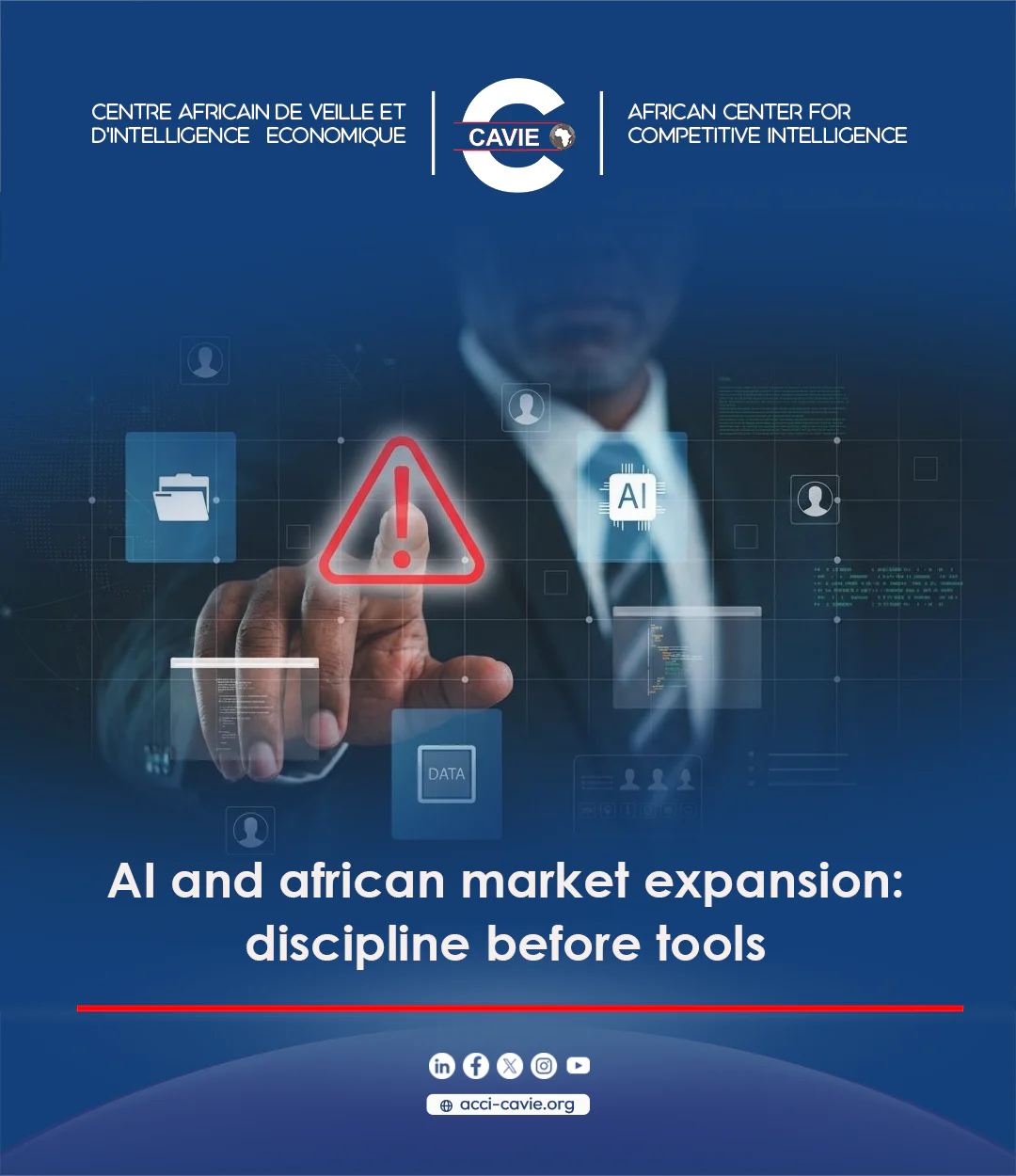
[CAVIE-ACCI] African companies are showing growing interest in artificial intelligence (AI). Investment is increasing, particularly in solutions designed to improve operational efficiency, data analysis and decision-making. Yet this momentum also reveals a less visible challenge: companies do not always have the methods needed to make effective use of these tools. Investing in artificial intelligence does not automatically lead to better market analysis. The issue is not only which tool to select or how much to spend on it. It is also the ability to ask the right questions, identify reliable sources and verify information before using it to support a strategic decision.
Investing in AI Is Not Enough
Integrating artificial intelligence into core business activities is one of the main challenges facing African executives today. This difficulty is particularly visible in market expansion projects. AI can quickly gather country reports, competitor data, regulatory information and pricing insights. It can also accelerate the classification and initial analysis of large volumes of documents. But speed of collection does not guarantee quality of judgment.
A generative system can produce a convincing answer based on solid information or on incomplete and poorly verified data. A market-entry recommendation built on weak sources may therefore look exactly like one based on rigorous research. Expansion decisions carry a particular risk in this respect. An error in an email can be corrected quickly. By contrast, a study that underestimates regulatory barriers, overstates demand or misreads a competitor’s position can direct a substantial budget in the wrong direction for several months.
Structure Before Generation
Organisations that derive real value from AI in research work generally follow the same approach: they define the structure of their analysis before asking a tool to generate content. They begin by clarifying what the company needs to know before deciding whether to enter a market. They then determine which sources can be considered reliable, which findings need to be confirmed and which assumptions require independent verification.
Artificial intelligence becomes particularly useful once this framework is in place. It can accelerate data collection, organise information and prepare an initial synthesis. It cannot, however, replace the research question, the analytical method or the criteria used to assess the quality of the findings. The risk is even greater in African markets, where the availability and reliability of data can vary significantly from one country or sector to another. A tool trained primarily on well-documented markets may produce fluent and confident answers about an environment where the available evidence is actually limited. Researchers must therefore identify gaps in the available data and determine which findings require field verification. The confidence expressed by a system is not proof that the information it provides is reliable.
What Decision Makers Should Put in Place
Before scaling the use of AI in market research, decision makers should establish three basic disciplines. First, define the research question and the required evidence standard before any AI-assisted collection begins. Generation should take place within a clear framework, not replace that framework.
Second, assign clear responsibility for verifying AI-generated findings. Any information that may influence a budget, a partner selection or a market-entry decision should be checked against independent sources and, when necessary, through local verification. Third, measure the actual value created. Companies should assess whether the tool helps them reach reliable decisions faster, reduce the resources spent on unsuitable markets or improve the quality of their commercial preparation. The mere fact that a company uses AI is not, in itself, a performance indicator.
The Tool Accelerates, Discipline Decides
Artificial intelligence does not eliminate the need for judgment, verification or accountability in market expansion research. It makes their absence even more costly, because a flawed conclusion can now be produced and circulated much faster. The issue is therefore not whether to choose speed or rigour. It is how to combine the data-collection and processing capabilities of AI with the verification discipline of experienced analysts.
This is the approach CAVIE brings to companies preparing to enter African markets: structured studies, critical analysis of data and thorough due diligence on projects and partners. The tool can accelerate collection; the analyst remains responsible for determining what can be verified, interpreted and ultimately used to support a decision.
The Editorial Staff