
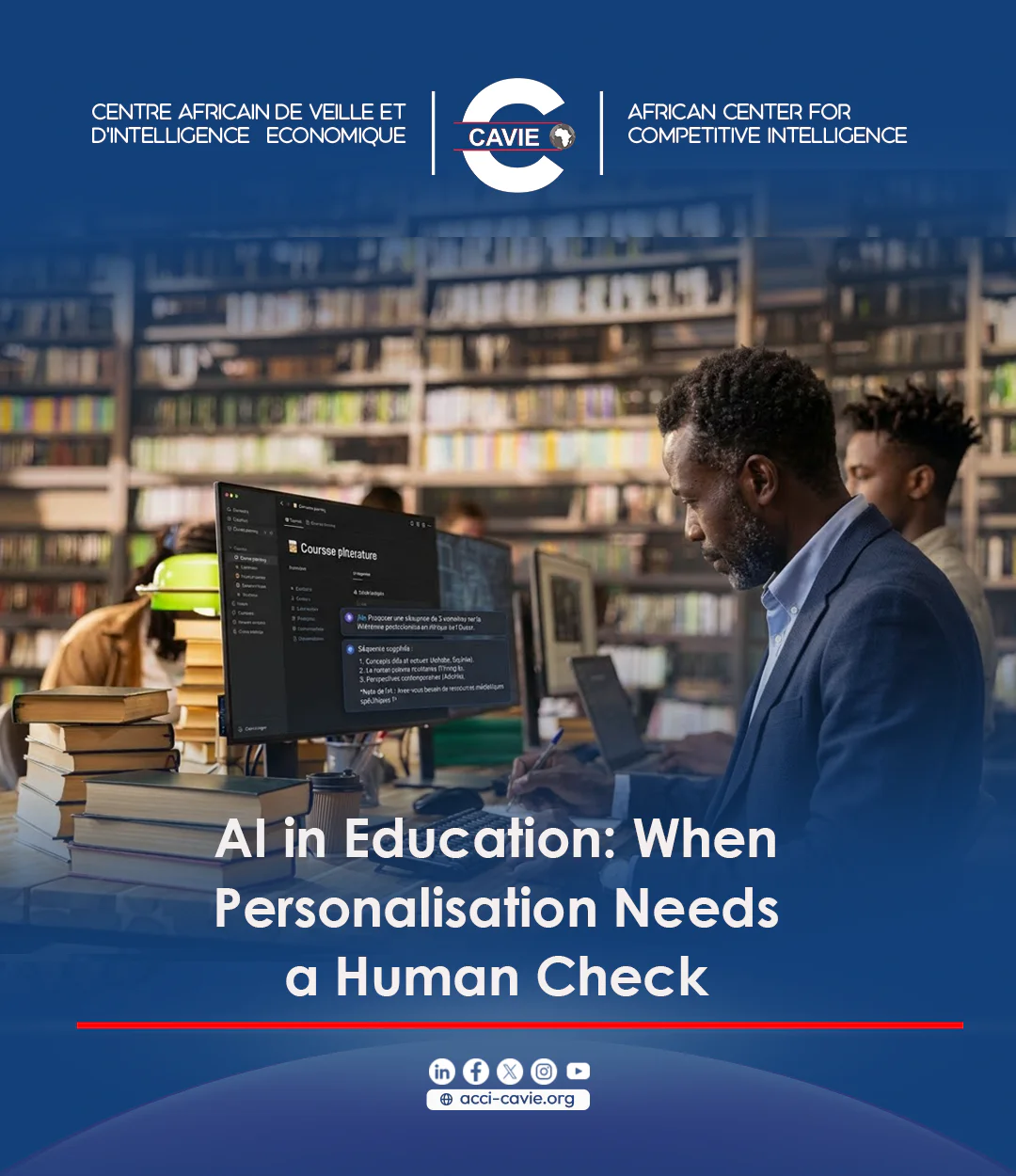
[ACCI-CAVIE] A student receives an exercise adapted to his level. A teacher generates a lesson plan in seconds. An institution analyses learning data to identify students who may need additional support. These uses of artificial intelligence are no longer theoretical. The more interesting question is what happens when the system becomes sufficiently useful to influence educational decisions. Personalisation can improve the learning experience. But an educational institution does not simply introduce a technology; it introduces a new way of producing, interpreting and using information about learners.
The useful answer is not always the right one
AI can process large volumes of information and generate recommendations much faster than a teacher or administrative team working alone. Yet speed does not guarantee relevance. A recommendation may be based on incomplete data, an inappropriate indicator or a model that does not adequately reflect the learner’s context.
This matters particularly when AI begins to influence assessment, orientation, content selection or student support. The question is no longer whether the tool can produce an answer, but whether the institution can understand why that answer was produced and decide whether it should be trusted.
UNESCO’s guidance on generative AI in education makes a similar distinction: institutions are encouraged to validate the pedagogical and ethical suitability of AI systems, protect data and maintain a human-centred approach. Its competency framework for teachers also places human agency, ethics and critical evaluation alongside technical AI skills.
Personalisation changes the information equation
The more personalised the educational service becomes, the more information it requires. Student performance, learning behaviour, preferences and interactions can become inputs into automated recommendations. This creates an important institutional question: which data should be collected, for what purpose, and under whose responsibility?
For an African school, university or training organisation, this question cannot be separated from its own operating environment. Data protection requirements, unequal access to digital tools, language and cultural context, teacher capacity and the reliability of available data can all affect the quality of an AI-supported educational system. UNESCO’s African education platform specifically highlights privacy, inclusion, linguistic and cultural diversity and institutional preparedness as issues that need to be considered when introducing generative AI.
The practical challenge is therefore not to put AI everywhere. It is to identify where it genuinely improves an existing process, define the information it can use, establish what must remain under human review and determine how the results will be assessed.
From experimentation to controlled use
This is where educational institutions can easily move too quickly. A successful experiment with an AI tool does not necessarily justify its deployment across an entire institution. Before scaling, decision makers need to know what the tool improves, what it changes and what new risks it introduces.
A useful starting point is therefore relatively simple: select one concrete use case, establish a baseline, secure the relevant data, test the quality of the outputs and measure the actual benefit. If an AI-assisted process saves time but increases correction work, creates unreliable recommendations or weakens teacher oversight, the apparent gain may disappear.
The objective is not to replace professional judgement with automated recommendations. It is to determine where technology can strengthen the work already carried out by educators and institutions without transferring responsibility to the system.
The real test is what remains under human control
AI will increasingly participate in teaching, learning and educational management. The institutions that benefit most from it may not necessarily be those that adopt the largest number of tools, but those that know where to use them, what information to trust and when human judgement must prevail.
This is consistent with the CAVIE’s broader approach to information and decision-making: technology becomes useful when it is placed within a disciplined process of collecting, qualifying, analysing and using information rather than treated as an end in itself.
For education leaders, the question is therefore becoming more concrete:
Where could AI improve our educational processes today and what safeguards must be in place before we allow it to influence a decision about a learner? That is where experimentation becomes governance, and where the adoption of AI can begin to create lasting institutional value.
The editorial staff