
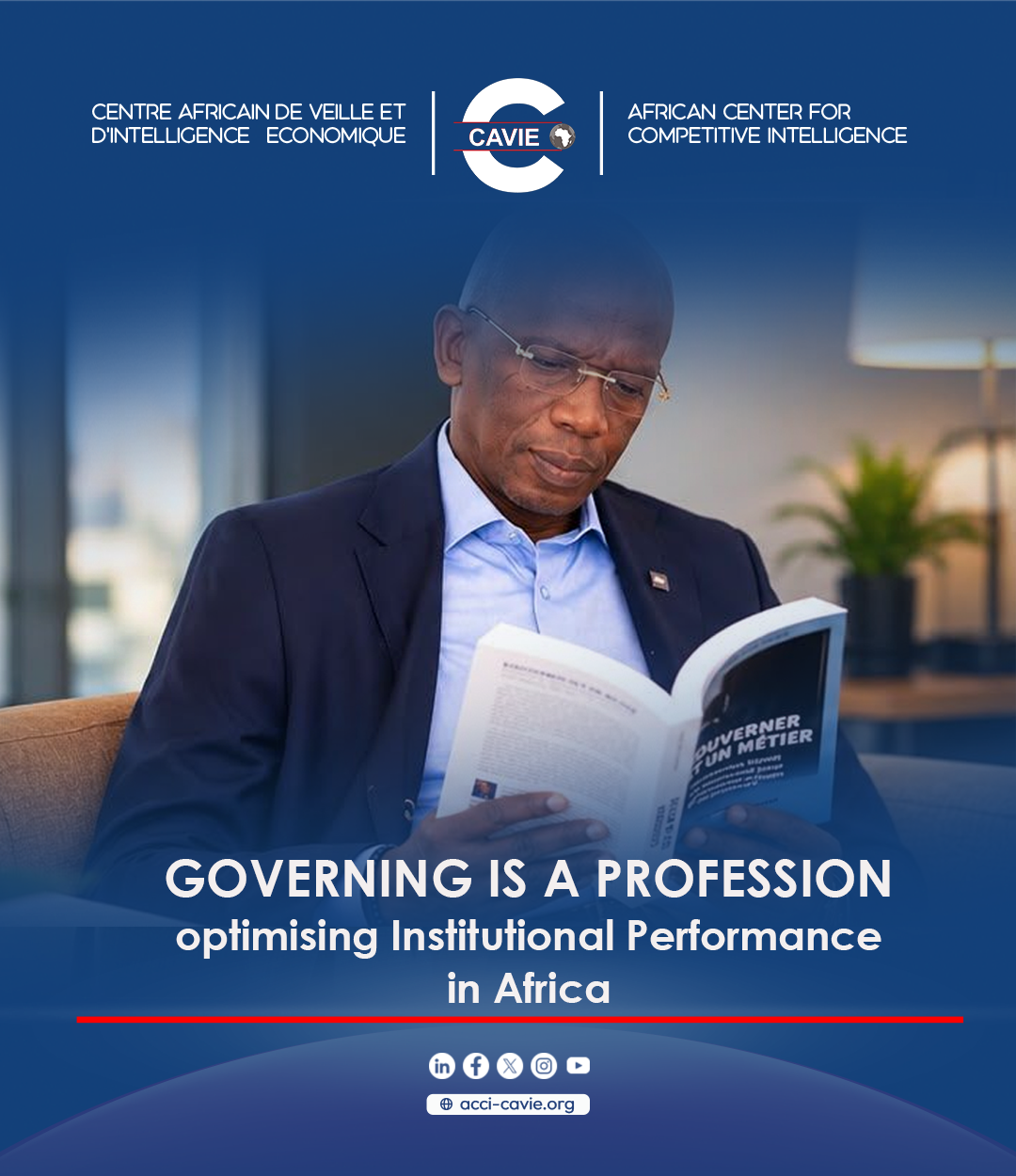
[ACCI-CAVIE] Africa is not short of resources, talent or ambition. What it often lacks are institutions capable of turning that potential into coherent decisions, continuity and tangible results. This gap between potential and the capacity to deliver lies at the heart of Dr Lansana Gagny Sakho’s “Governing Is a Profession: Experiences, Lessons and Recommendations from an African Practitioner”. Drawing on three decades of experience, the author puts forward a simple but fundamental proposition: governing requires skills, methods and institutions built to last.
Africa’s Challenge Is Also a Challenge of Method
The figures illustrate the paradox. Africa holds 30% of the world’s mineral reserves and 60% of the world’s uncultivated arable land, while its population is expected to reach 2.5 billion by 2050. Yet the continent continues to attract only a limited share of global investment and faces persistent challenges in trade and industrial integration.
These gaps cannot be explained solely by a lack of capital or infrastructure. They also raise questions about the ability of institutions to organise, arbitrate, execute and sustain public action over time.
“Africa does not have a potential problem. It has a problem of method. And method can be learned, passed on and built.”
For Dr Lansana Gagny Sakho, institutional method rests on several fundamentals: competence, rigour, accountability, continuity and performance evaluation. Governing therefore cannot be treated as a function that can be performed without specific preparation. It requires professional standards, sound decision-making and a genuine culture of execution.
Competence Must Return to the Centre of Decision-Making
Professionalisation begins with the selection and preparation of those entrusted with public responsibilities. Academic qualifications alone do not guarantee the ability to lead a reform, manage competing interests or turn a strategy into results. Public administrations need people who understand their environment, anticipate risks and make decisions based on reliable information.
The same principle applies to employment and entrepreneurship policies. With its working-age population growing rapidly, Africa must turn demographic expansion into productive capacity. This requires closer alignment between education and training, business needs, access to finance and industrial policy. Entrepreneurship cannot be reduced to a response to unemployment. It must be embedded in ecosystems capable of nurturing competitive and sustainable businesses.
An Institution Must Outlive Its Leaders
The quality of an institution can also be measured by what remains after its leaders have left. When every change of leadership results in the loss of methods, networks and organisational memory, public administration is forced to start over instead of building on what has already been achieved.
Dr Lansana Gagny Sakho’s experience at the Rural Boreholes Agency (OFOR) and the National Sanitation Agency of Senegal (ONAS) illustrates this imperative of continuity. Reforming an institution is not simply a matter of changing its organisational structure or setting new objectives. It means building systems capable of preserving achievements, transferring expertise and carrying the institution’s mission forward beyond individuals.
“Africa does not suffer from a shortage of talent. It suffers from a shortage of institutional discipline.”
This institutional discipline is one of the book’s central themes: a strategy has value only when an organisation has the human, informational and administrative capacity to implement it.
Competitive Intelligence as a Capacity for Action
This requirement is directly connected to the strategic value of information. For African governments and businesses alike, Competitive Intelligence helps identify risks, understand value chains, detect strategic positions to be secured and strengthen decision-making.
Information, however, has value only when it creates the capacity to act. This is precisely where the mission of the African Center for Competitive Intelligence (CAVIE) converges with the book’s central argument: developing monitoring, analytical and foresight capabilities is essential to better-informed decisions and sustainable competitiveness.
From this perspective, Competitive Intelligence is also a matter of sovereignty. A country that has limited knowledge of its markets, dependencies, competitors or negotiating leverage inevitably reduces its ability to defend its interests.
Attractiveness Begins with Trust
Dr Lansana Gagny Sakho’s experience at the National Agency for the Promotion of Investments and Major Projects (APIX-SA) extends this reflection into another area: investment attractiveness. Investors do not choose a market solely because of its resources or potential. They also assess the predictability of its rules, the stability of its environment, the quality of its institutions and the state’s ability to honour its commitments.
Attractiveness is therefore first and foremost a matter of institutional trust. It is built through consistent public policies, effective administration and the ability to reduce the uncertainty inherent in every economic decision.
From Ambition to Execution
Throughout the book, five priorities emerge: professionalising the selection of public leaders, preserving institutional memory, strengthening Competitive Intelligence, bringing education and training systems closer to the needs of economies, and building institutions capable of lasting.
All five point to the same imperative: moving from a culture of intent to a culture of execution. Development depends not only on the relevance of the policies that are designed, but also on the ability of institutions to implement them consistently, competently and methodically.
“Nothing is lost. Everything can be rebuilt.”
This is ultimately the significance of Governing Is a Profession. Dr Lansana Gagny Sakho does not offer a universal formula for governance. Instead, he sets out a clear requirement: to make competence, institutional continuity and mastery of information instruments of economic transformation.
For CAVIE, this reflection echoes a fundamental conviction: a state’s competitiveness is measured not only by the resources it possesses, but also by its ability to understand, protect, develop and turn those resources into strategic decisions. Governing is indeed a profession. And like any strategic profession, it must be learned, refined and passed on.
Dr Lansana Gagny Sakho, an electrical engineer with an MBA and a PhD in Management Sciences, is a former Director General of the Rural Boreholes Agency (OFOR) and the National Sanitation Agency of Senegal (ONAS). He chairs the Board of Directors of the National Agency for the Promotion of Investments and Major Projects (APIX-SA) and serves as Secretary General of the African Center for Competitive Intelligence (CAVIE). His book, Governing Is a Profession: Experiences, Lessons and Recommendations from an African Practitioner, was published by L’Harmattan-Sénégal in 2026.
The Editorial Staff