
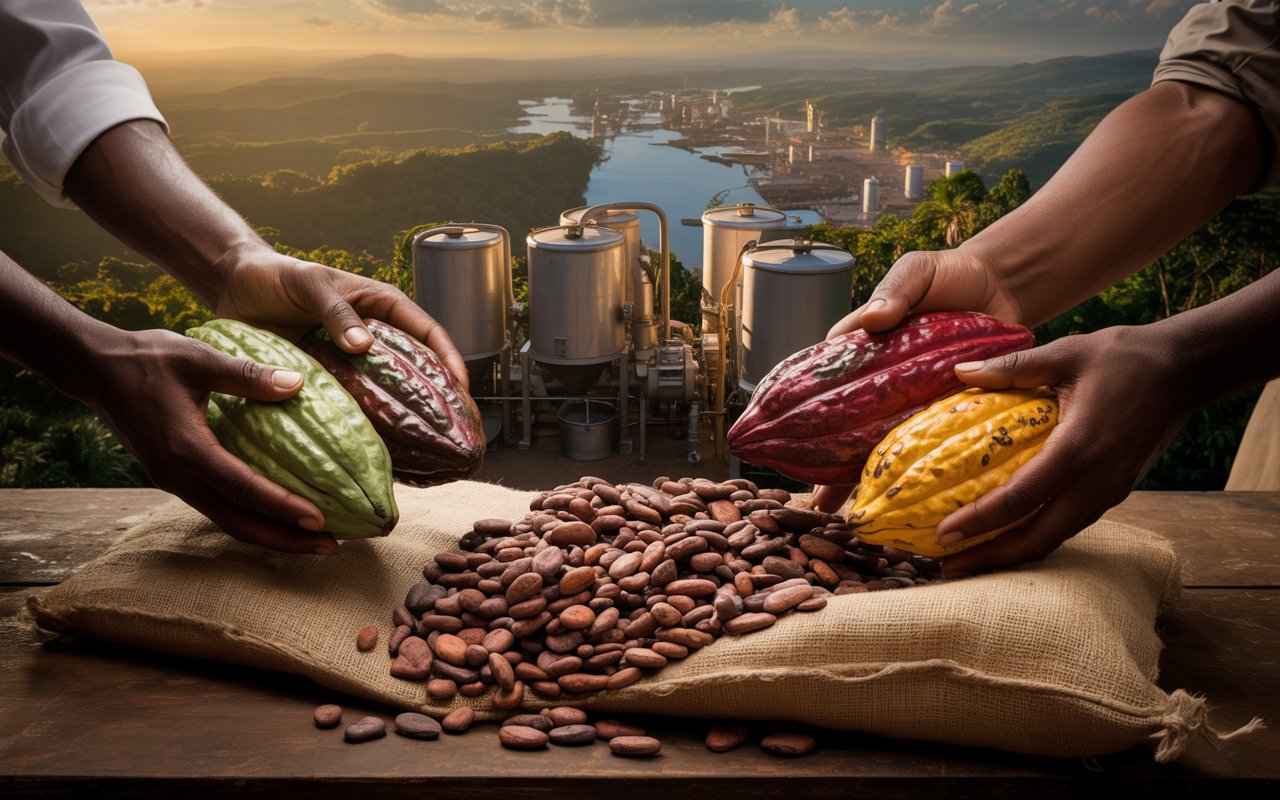
[ACCI-CAVIE] As cocoa prices face extreme volatility in London and New York, Africa is leveraging economic intelligence to reclaim control over its “brown gold.” This article explores how shifting from raw exports to local processing can quadruple the value captured by producers. Discover how CAVIE’s strategic approach provides African states with the monitoring and influence tools needed to break speculative cycles.
The global cocoa economy is navigating unprecedented turbulence in early 2026. As prices on the London and New York exchanges exhibit baffling volatility, the gap between the value of raw beans and finished products has never been more striking. For Africa, which accounts for over 60% of global supply, this situation presents a fundamental challenge to its sovereignty. The goal is no longer merely to produce more, but to master information and the value chain. This article analyzes how economic intelligence, as defined by the African Center for Economic Intelligence (ACCI-CAVIE), can serve as the catalyst for local processing and the competitiveness of the sector.
Competitive intelligence as a strategic shield
The African approach to economic intelligence goes beyond simple media monitoring. According to CAVIE, it constitutes a mindset and a coordinated process of collecting and analyzing intelligence useful for decision-making in hostile environments. In the cocoa sector, this environment is characterized by the dominance of multinationals and market speculation.
Implementing this framework allows African stakeholders to break away from historical passivity. By converting information into actionable decisions, they can anticipate cycle reversals, such as the price drops observed following the record highs of 2025. Economic intelligence provides the tools to monitor the strategies of processing giants and detect “weak signals,” such as evolving European environmental standards or emerging consumer segments for organic and fair-trade cocoa.
Local processing: a value equation
The transition from raw exports to industrialization is the pivot of economic sovereignty. The figures are telling: while a ton of raw cocoa trades between 3,000 and 4,000 dollars, processing it into finished chocolate can generate a value of up to 15,000 dollars.
This fourfold increase in value is the only lever capable of sustainably stabilizing farmers’ incomes, moving beyond emergency interventions like the 280 billion FCFA mobilized by Abidjan. The competitiveness of African cocoa now depends on the ability of states to invest in regional industrial units. Economic intelligence plays a role here by identifying the most suitable processing technologies and mapping niche markets where African cocoa butter and powder can prevail without being subject to the whims of Western exchanges.
Toward concerted regulation and data mastery
Sovereignty cannot be achieved in isolation. Expanding the Côte d’Ivoire–Ghana Cocoa Initiative (CIGCI) to include other African producers is a necessity to gain leverage against global buyers. This coalition must be backed by sovereign data infrastructure. By possessing reliable, real-time statistics on actual stocks and harvest forecasts, Africa can counter the misinformation that often fuels artificial price drops.
The mastery of legal and secure information, a pillar of the CAVIE definition, strengthens bargaining power during major international summits. The objective is to shift from a subsistence economy to an economy of influence, where the producer becomes a price setter.
In conclusion, the current price volatility crisis serves as a strategic warning highlighting the obsolescence of the colonial model of raw material exportation. Africa’s economic sovereignty will necessarily depend on a trilogy of concerted regulation, massive industrialization, and robust economic intelligence. By adopting this new mindset, the continent will cease to be merely the world’s raw material reservoir and become the true master of its “brown gold.” The challenge now is to open the perspective of an African commodity exchange, capable of reflecting ground realities rather than the interests of speculators.
Lansana Gagny Sakho
Secretary General of CAVIE